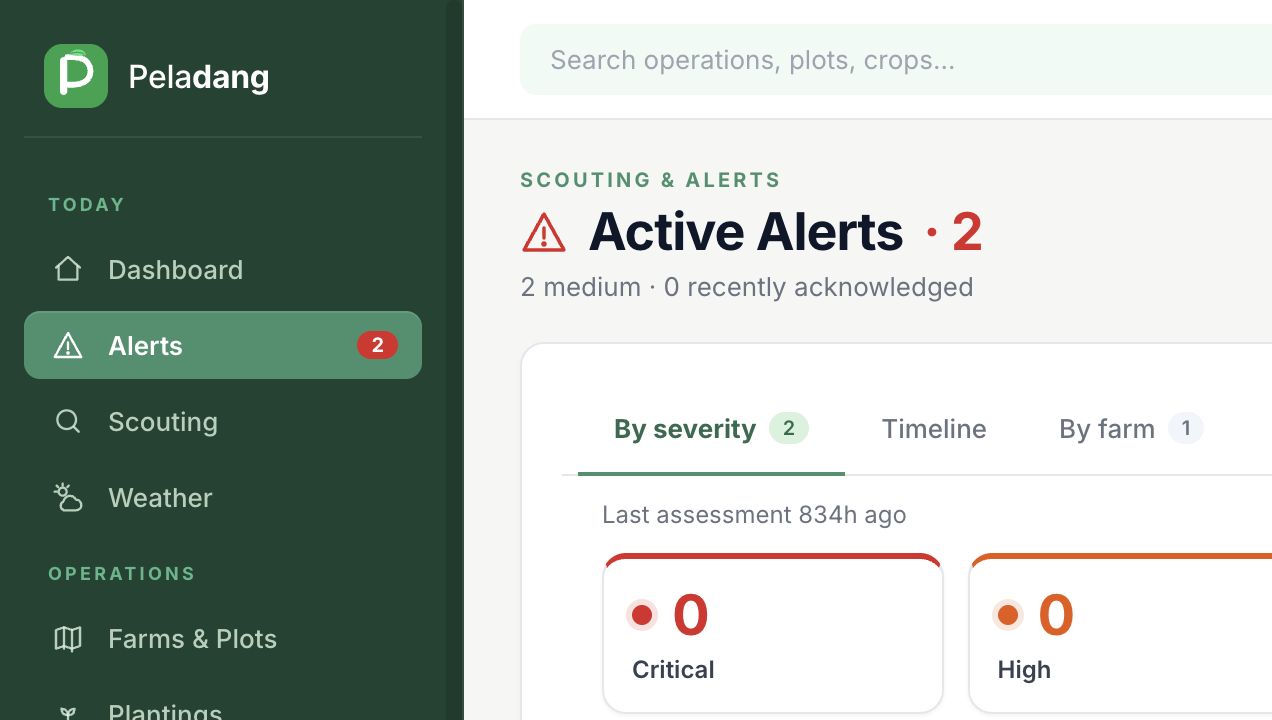
Crop disease alerts only save yield when they change what a farmer does in the next few hours. That is the practical difference between a generic weather app and a farm workflow. Peladang’s alert system combines 14-day weather forecasts with actual field scouting records from your farm, then surfaces the highest-risk plots on one dashboard. For Malaysian growers, that matters because the same week of heat and humidity can mean very different things for padi at panicle initiation, chili under fruit load, or young durian under canopy stress. A useful alert is not just “rain is coming.” It is a signal that says which plot is exposed, why the risk is rising, and what to inspect before disease pressure becomes visible across the whole block. Used correctly, this turns disease response from late firefighting into early, targeted action.
Why a generic weather forecast is not enough
Most small farms already check the weather. The problem is that rain probability alone does not tell you whether rice blast, chili anthracnose, powdery mildew, sheath blight, aphids, leaf curl virus, or leaf folder pressure is actually increasing on your farm. Disease spread depends on crop stage, canopy humidity, recent symptoms, and whether the field already showed stress in the last scouting round. If a platform cannot connect those dots, the farmer still has to interpret everything manually.
That is where Peladang changes the workflow. Instead of forcing the grower to remember last week’s field notes and mentally compare them with the next 14 days of weather, the system brings both into one place. The result is a clearer answer to the real question Malaysian farmers ask: “Which plot should I walk first this morning, and what am I looking for when I get there?”
The five-step workflow that makes alerts useful
- Pin the farm accurately. Forecast quality starts with location quality. If coordinates are wrong, humidity and rainfall patterns will be wrong too.
- Keep crop stage current. A chili block at flowering should not be treated like a newly planted tomato plot. Update plantings so risk is interpreted against the right stage.
- Log field scouting, even when nothing is wrong. “All clear” observations are useful because they create a baseline. The system can distinguish new pressure from stable conditions.
- Open the alerts page every day, not only when there is a problem. Good alert use is a routine, not an emergency-only behavior.
- Record the follow-up action. If you scout, spray, prune, isolate, or decide to wait, log that result. This turns the next alert into a better decision instead of another disconnected notification.
What a “good” alert looks like
A good alert narrows your attention. It should help you decide where to go, what symptom to check, and whether the cost of action is lower today than it will be two or three days from now.
How to read severity without overreacting
Not every alert means you should spray immediately. The point of a risk system is to prioritize attention, not create panic. A medium alert is usually a cue to inspect the plot sooner and confirm conditions on the ground. A high alert means the combination of weather and scouting evidence is strong enough that a delay could become expensive. Critical alerts should trigger the fastest response, especially on crops where missed timing is hard to recover from, such as rice blast close to the neck stage or fast-moving chili disease after prolonged humidity.
The mistake to avoid is treating every alert as identical. The right move is to pair the alert page with a fast scouting walk: check leaf wetness, visible lesions, insect pressure, and how localized the issue still is. If the plot still looks clean, you may choose monitoring over treatment. If symptoms are emerging in the exact block the alert flagged, you can act earlier and more precisely.
The minimum response playbook for small farms
- Open the highest-severity alert first and note the affected farm and plot.
- Walk that plot before lower-priority work starts for the day.
- Take photos or notes during scouting so the decision is documented.
- Apply targeted treatment only if field evidence confirms the risk.
- Log the action so owners, workers, and advisors can see what changed.
- Recheck the plot after the next weather swing instead of assuming the problem is closed.
Where this fits inside Peladang
The alerts page works best when it is part of a larger routine. Daily checks create the raw field signal. The 14-day weather forecast gives the forward-looking pressure context. Field scouting records capture what was actually seen. Then the alert view turns those records into a ranked list of what needs attention now. For farm owners managing several plots, this replaces guesswork. For workers, it creates a more specific morning brief. For advisors, it shortens the time between remote review and on-the-ground action.
If you want the broader feature overview, see Peladang’s disease monitoring page. If you want a simpler manual scoring method for planning risk before you adopt software, read our pest and disease risk scoring guide.
Related Resources
Start using alerts on your own farm
Create a free Peladang account, add your plots, and begin logging scouting rounds so the next weather shift produces a useful signal instead of a surprise.
Create Your Free Farm Account