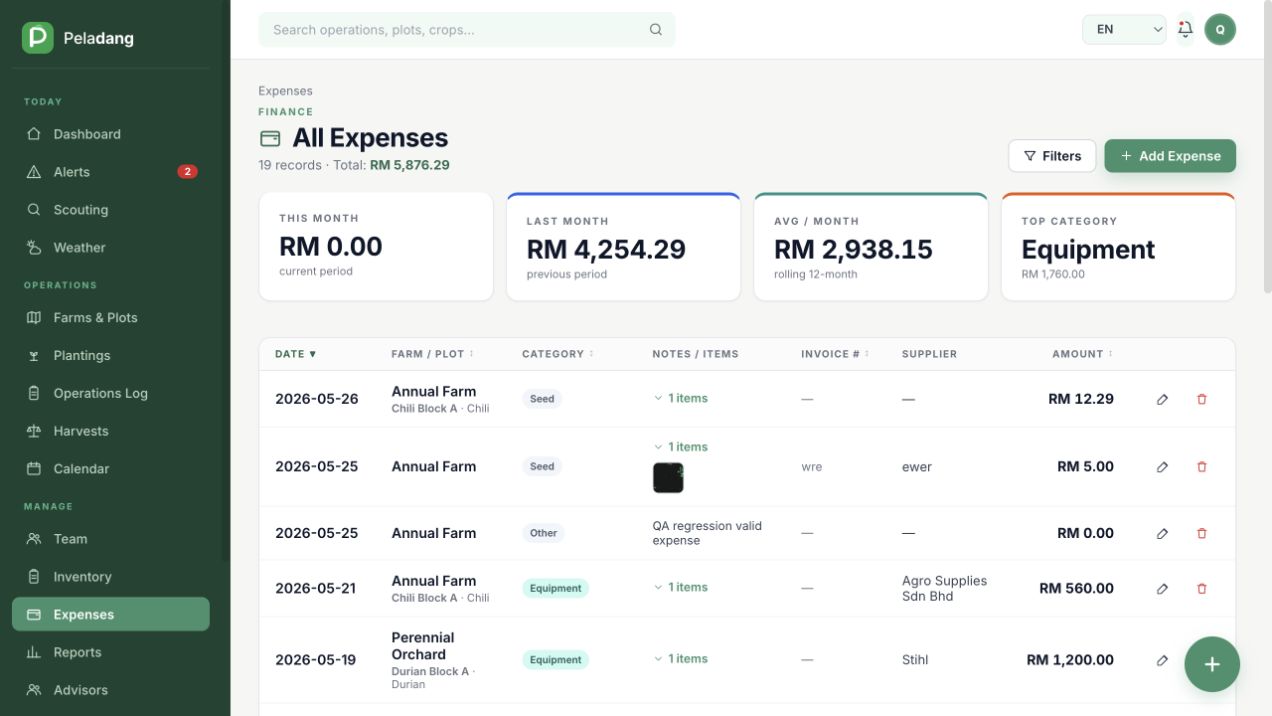
Many small farms in Malaysia know their sales number, but not their actual profit. That sounds minor until a farmer finishes a season thinking it went well, only to discover later that fertilizer, labour, spraying, transport, and replacement inputs quietly erased the margin. True farm profitability tracking is not complicated accounting. It is a disciplined record of what each plot cost, what it produced, and what price it achieved when sold. Peladang’s workflow makes that easier by letting growers log expenses at the farm and plot level, review category totals, and compare cycles without building a spreadsheet from scratch every month. When this is done consistently, the owner can see whether a chili block beat a tomato plot, whether a new fertilizer regime actually improved returns, and whether a buyer offering a slightly higher price still produced lower net profit after extra handling costs.
Why most small farms overestimate profit
The usual failure is not that farmers never record anything. It is that costs are scattered across memory, notebooks, supplier receipts, family WhatsApp messages, and cash purchases made by different people on different days. Revenue is remembered because money comes in all at once. Costs disappear because they are paid in pieces. This makes a farm look healthier than it really is.
Another common mistake is mixing all plots together. If one block performs well and another struggles, the blended total hides the truth. The owner sees a farm-level number, but cannot tell which decision actually created the profit. That means next season’s plan is based on intuition rather than evidence.
The minimum data you need for real profitability
- Input costs: seed, seedlings, fertilizer, chemicals, mulch, irrigation parts, and packaging.
- Labour costs: wages, contractor fees, and any task-specific outside help.
- Equipment and repair costs: pump repair, brush cutter maintenance, hoses, trays, and other replacements.
- Harvest data: date, quantity, grade if relevant, buyer, and selling price.
- Transport and selling costs: delivery, market fees, and post-harvest handling that reduce net return.
You do not need enterprise accounting software to get useful answers. You just need discipline about timing and attribution. If an expense is entered late, or attached to the wrong plot, the final report becomes harder to trust.
The five-step workflow that works on real farms
- Enter costs on the same day. A five-minute habit is better than a two-hour monthly catch-up that never happens.
- Attach each cost to the correct plot or cycle. If a fertilizer order covered two blocks, split it.
- Use categories consistently. Seeds should stay under seed, labour under labour, and equipment under equipment. Otherwise category trends become meaningless.
- Capture harvest revenue with the same discipline as costs. A season is not profitable just because yield was high; price still decides the outcome.
- Review the report before the next planting decision. The point is not bookkeeping for its own sake. The point is better crop and buyer decisions next cycle.
A useful profitability report answers three questions
Which plot made money? Which category drove the cost increase? And if you repeated this exact cycle next season, would you choose the same crop, the same inputs, and the same buyer?
How to turn raw entries into a decision
Once the data is in place, the analysis becomes straightforward. Compare total expense against total revenue for each planting cycle. Then go one level deeper: look at cost per plot, cost per kilogram, and margin by buyer where relevant. This is where growers often discover that the “best-looking” crop was not actually the most profitable one.
For example, a tomato plot may show good volume but poor net margin because labour and nutrient costs climbed faster than expected. A chili block might have lower yield but stronger margin because the selling price held up and disease losses stayed controlled. Without plot-level cost tracking, both stories disappear inside one blended total.
Where Peladang helps most
Peladang’s finance workflow is designed for growers who need operational clarity, not accountant jargon. The expenses screen gives a live ledger by month and category. The reports layer connects that spending back to specific plots and crop cycles. When the whole team records costs and harvests consistently, the owner gets a real operating view instead of a guess built from memory.
If you are still comparing software options, the broader context is covered in our farm app comparison page. If you want the bigger overview of what a Malaysian farm app should do beyond finance, read our farm management application guide.
Related Resources
Start tracking profit before the season ends
Use Peladang to log costs as they happen, keep harvest revenue attached to the right plot, and see which crop cycle actually paid off.
Track My Farm Costs for Free